Digitisation:OnboardingyourbusinesswithCommBank
An Australian banking first digital application that allows business customers to 'onboard' their business, directors and beneficial owners as well as originate their product with CommBank. All through a seamless and intuitive digital application known as Project Path.
The current landscape of starting a business transaction account with CommBank
Complex paper-based applications (up to 50 pages) and business rules often lead to rework from human error and miscommunication.
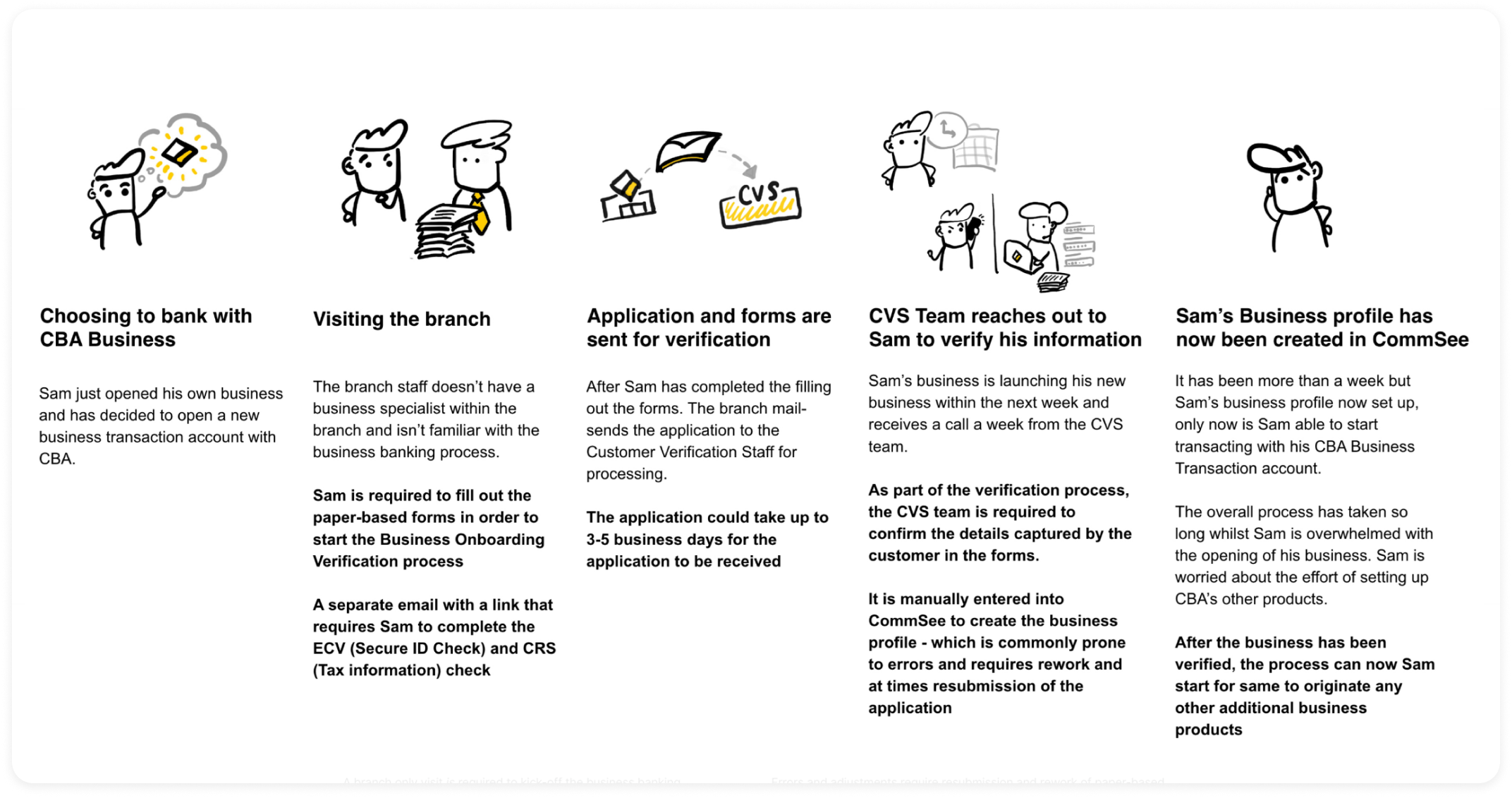
Journey mapping to help stakeholders understand how cumbersome and slow, opening a business account with CBA is currently - businesses’ shouldn’t need to wait up to a week to start transacting with their customers.
Aligning stakeholders and conceptualizing our ideas effectively
Through the process we focused heavily on aligning stakeholders and conceptualizing our ideas effectively. Starting from understanding the problem, gathering information, and defining the project scope. We conducted ideation sessions with our stakeholders and SMEs during this crucial stage of the design process to understand their perspectives and ideas that can be incorporated, leading to a solution that is more closely aligned with their needs and expectations.
Going down a more structured design process helps to break down complex problems into manageable parts and provides a clear framework for thinking through different solutions.
Educating and also creating transparency on the design roadmap was key to building effective relationships within the encompassing product teams.
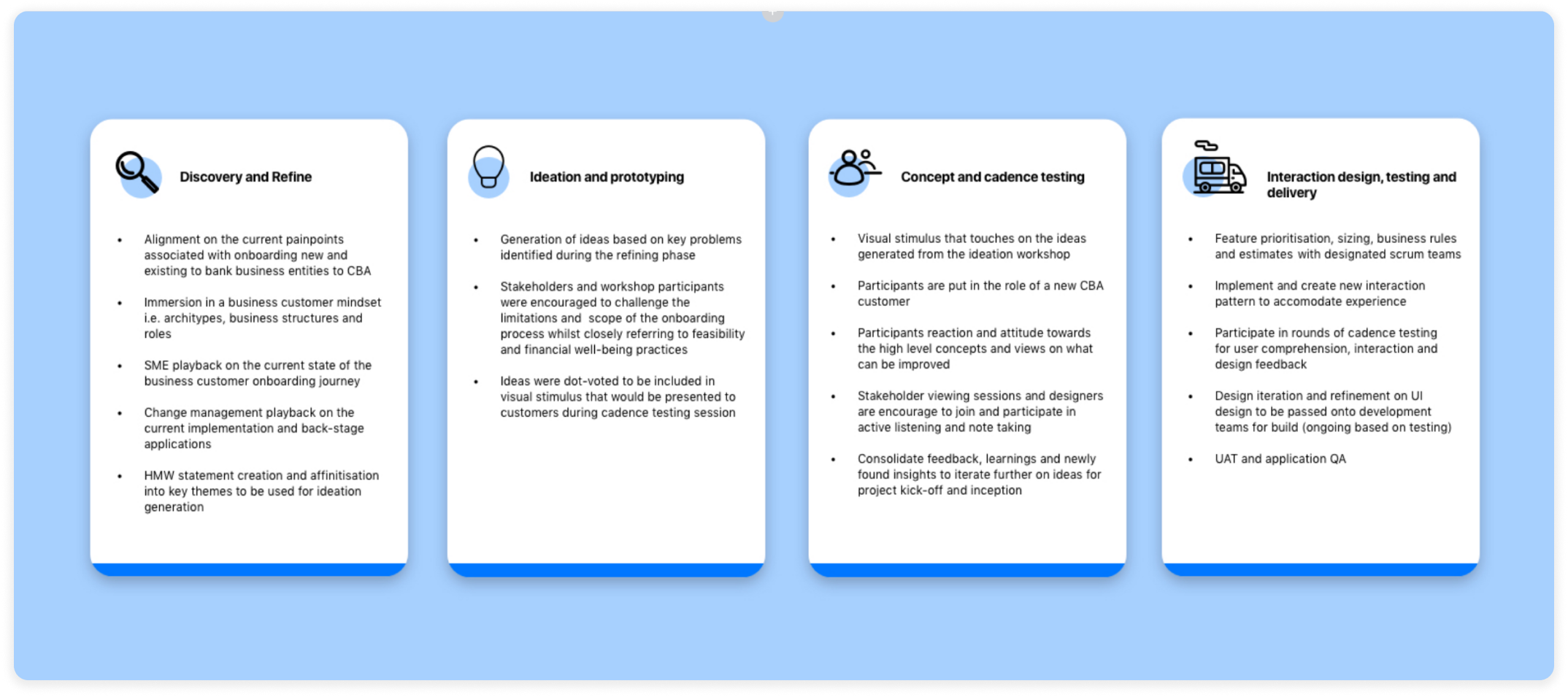
At the start of our discovery phase, our team came together to determine the critical elements of our business and establish a clear direction for our efforts. During this time, each team member recorded their insights in the form of "How Might We" statements. These statements were then grouped into overarching themes, providing us with a set of key opportunity areas to explore further during the ideation phase. The process of refining and categorizing our observations allowed us to focus our efforts and provided a solid foundation for our creative problem-solving efforts.
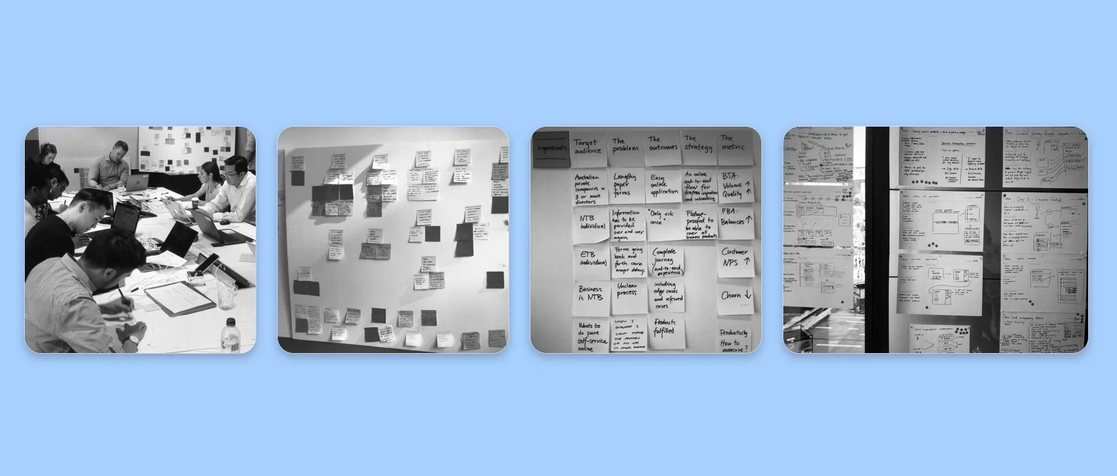
To further refine our solution, we provided the team with an opportunity to vote on the idea they believed would offer the most impactful solution. This approach allowed us to narrow down our options and focus on the most promising ideas, ensuring that our efforts are directed towards creating a solution that will have the greatest impact for our customers.
Empower our frontline
Guide the branch conversation - "Triage" empower our banking staff with the ability to guide the conversation with potential business customers. i.e. early training, involving them in early piloting.
Utilise our digital assistants
Leverage existing Digital Assistant channels, i.e. Chatbot, Online chat with a business banker where are potential roadblocks in the application process.
Automated onboarding experience for involved parties
Nudging involved parties who haven't been identified and the capability to speed up the KYC (Know Your Customer) process.
Consistent experience for both our end users
Consistent UI for Customer Verification Staff (Internal team) to have a similar UI application as a customer for easy walkthrough and communication
Meaningful cross-sell
Provide meaningful cross-sell during end-to-end application by bundling merchant terminals and branch transactions.
Set expectations and timeframes
Always provide the next steps with a status tracker that allows customers to leave the application and then returned to guide them where they left off.
As the sprint team, we refined our top ideas and ended the day by building end-to-end customer journeys utilising the top ideas/concepts generated in the ideation workshops. We formed individual groups to construct what this might look like as a holistic service journey.
From a business perspective, we refined the data requirements for both customers and the Customer Verification Staff. During the customer onboarding process, we streamlined the verification process by eliminating the need for duplicate data capture over the phone.
Research planning and concept testing
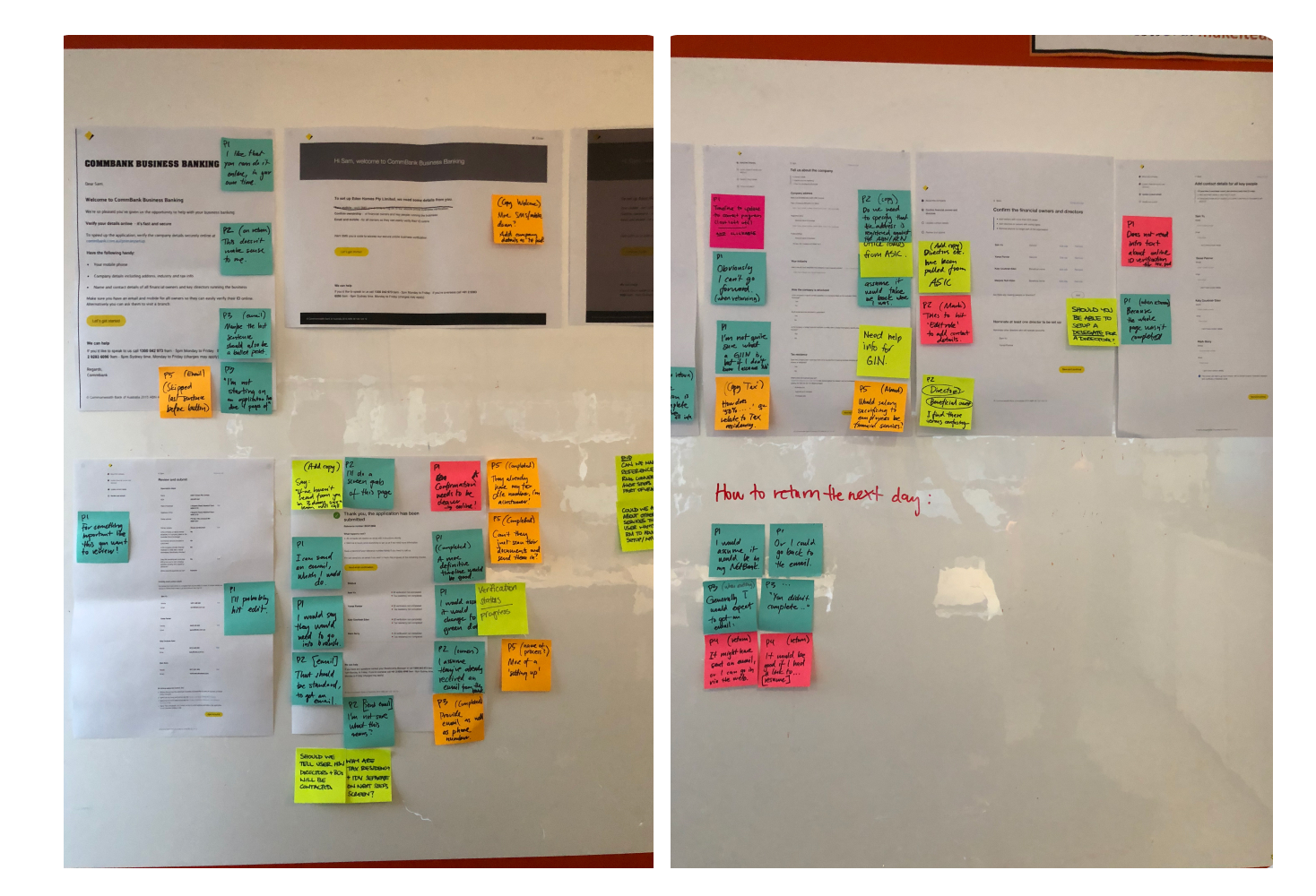
The design team worked closely with the research team to develop a research plan for the product team's upcoming customer testing. We also finalised the scenario that would be used as a basis for the testing, making sure all relevant ideas and concepts were integrated into a coherent narrative.
Storybook concept tested with 8 business banking customers. Despite initial preference for in-person account opening (due to document sighting requirements), participants preferred applying online after experiencing the prototype. The process was perceived as easy, straightforward, and seamless.
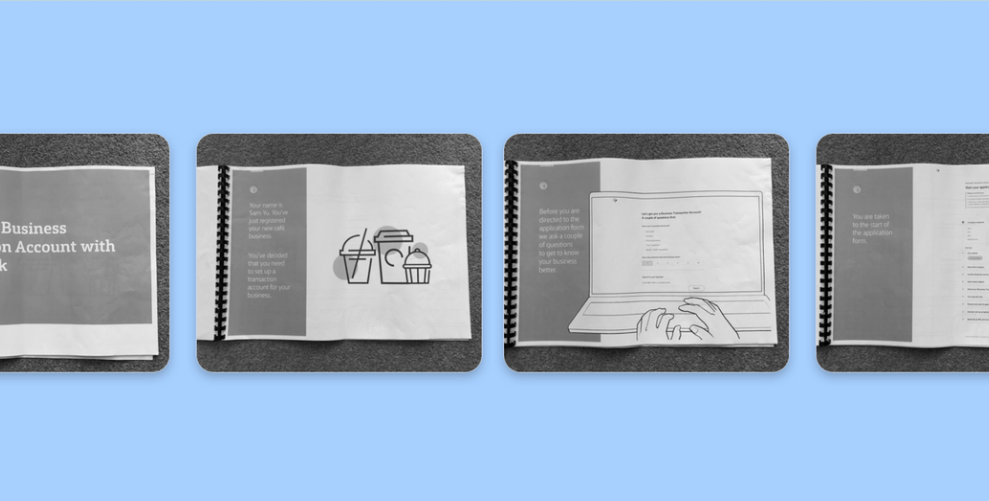
During cadence testing, we invited the scrum to attend viewing sessions throughout the day. This allowed our team and stakeholders to see customer feedback firsthand on features proposed during BCO ideation workshops. We also facilitated active listening sessions where they could contribute observations to our testing hypotheses.
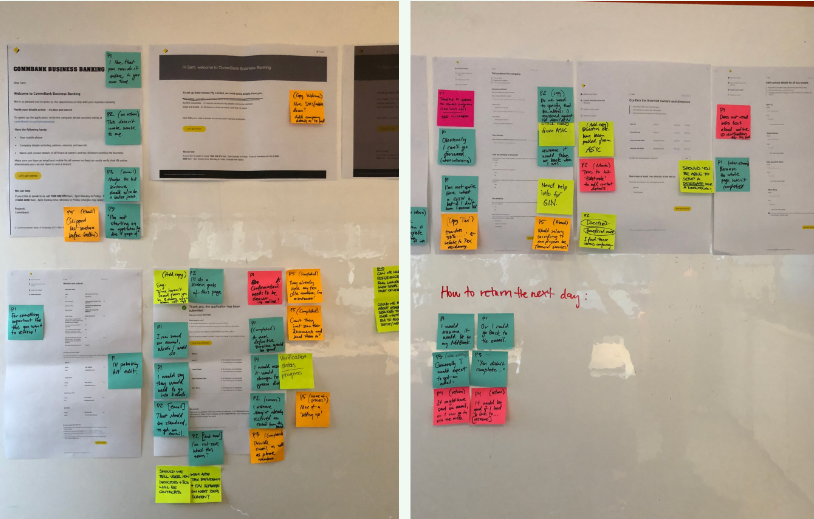
User testing generated strongly positive reactions across all participants.
Common themes were the simplicity of completing the process independently, the straightforward questions, and surprise at how fast the experience felt. Several participants were also open to bundling the application with other business tools for a more complete origination experience. Key insights that shaped our content and interaction design:
After conducting several rounds of testing with business customers, we emphasized the following key areas:
- Streamlining language and minimising the use of banking jargon, as well as providing clarification when uncertainty arises.
- Improving the ease of navigation and reducing the number of errors by simplifying interface elements.
- Ensuring that digital assistance is readily available when needed and that it is provided by a human, as customers expressed a preference for chatbots, which they felt were not intelligent enough.
- Provide an avenue for staff to be able to access to acquire information readily i.e. help centre, application experts
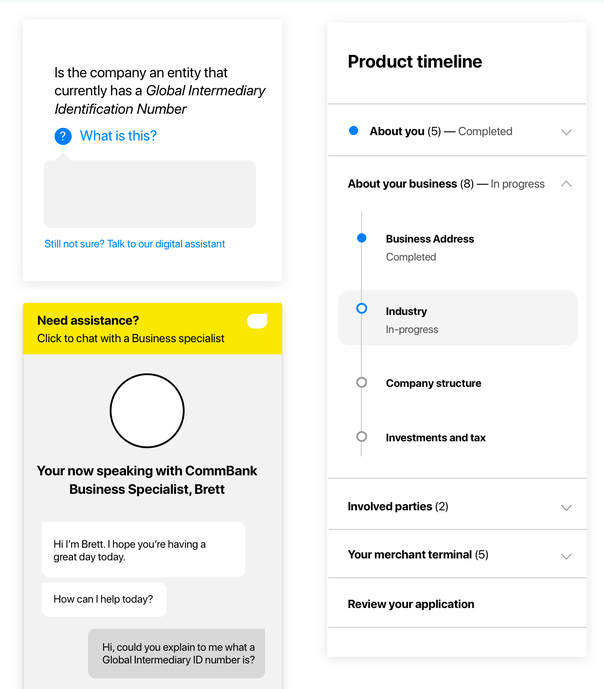
Creating a robust origination pattern ...
We identified the need to link customers' business accounts to other CBA products and provide a seamless and intuitive origination experience. However, the existing origination UI framework was inadequate to handle a lengthy and intricate flow.
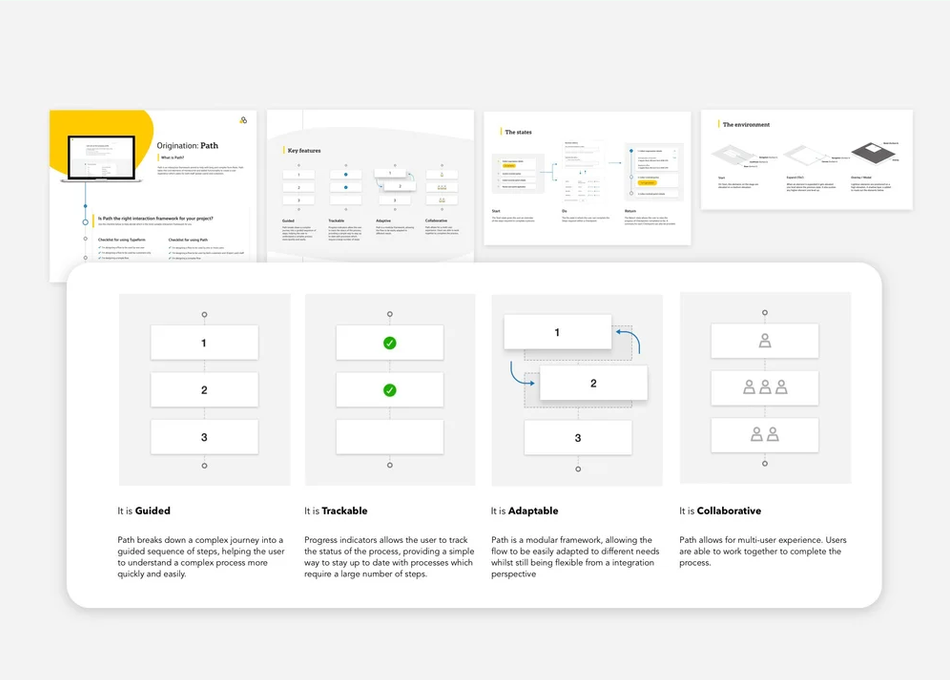
Therefore, there was a pressing design requirement to create a new, advanced origination framework, now referred to as "Path" by CommBank product teams. The framework is characterized by its modular design that allows for easy modification, addition, and customization of flows based on the product chosen by the business customer.
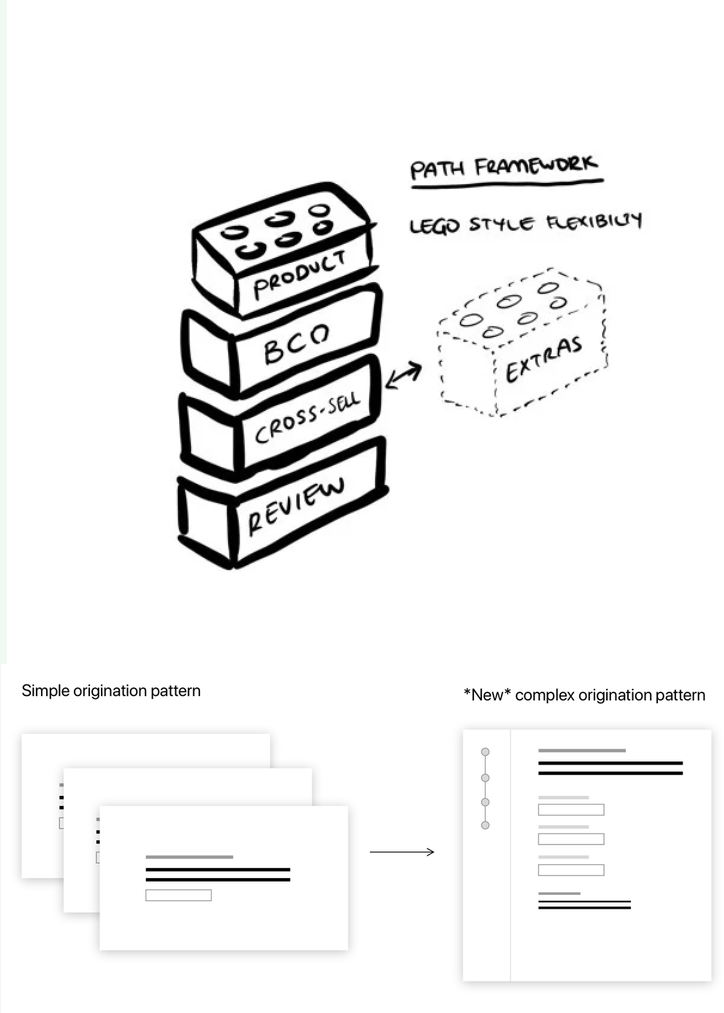
The BCO project was able to pave the way for a complex origination pattern that the CBA design library was missing. A whole new pattern was documented and created for the wider design team to utilise in their project. e.g. Home Loans applications and insurance applications.
... and differentiating between simple and complex application flows
The current CommBank origination process utilized a conversational interaction framework known as Typeform, which presented questions one at a time, allowing customers to progress through simple questions in a single session.
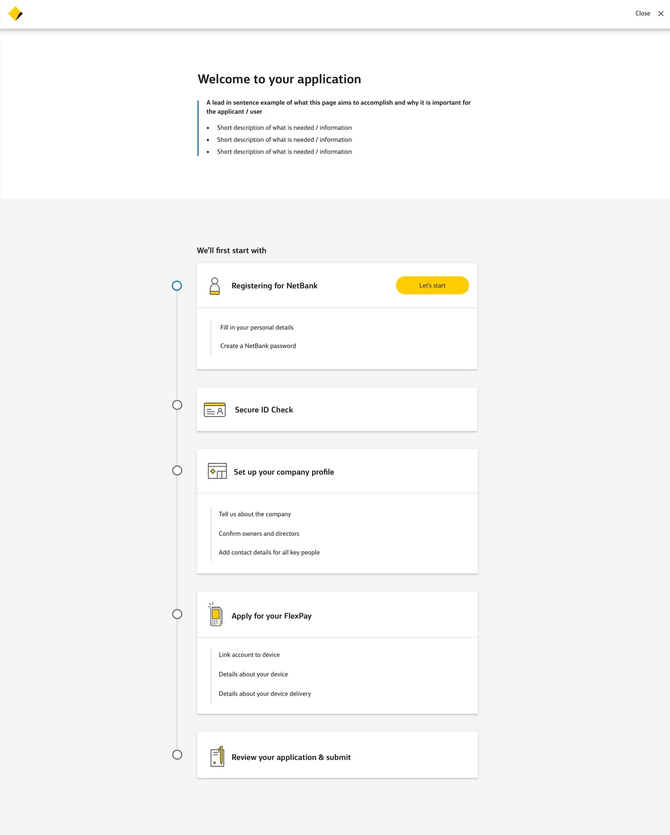
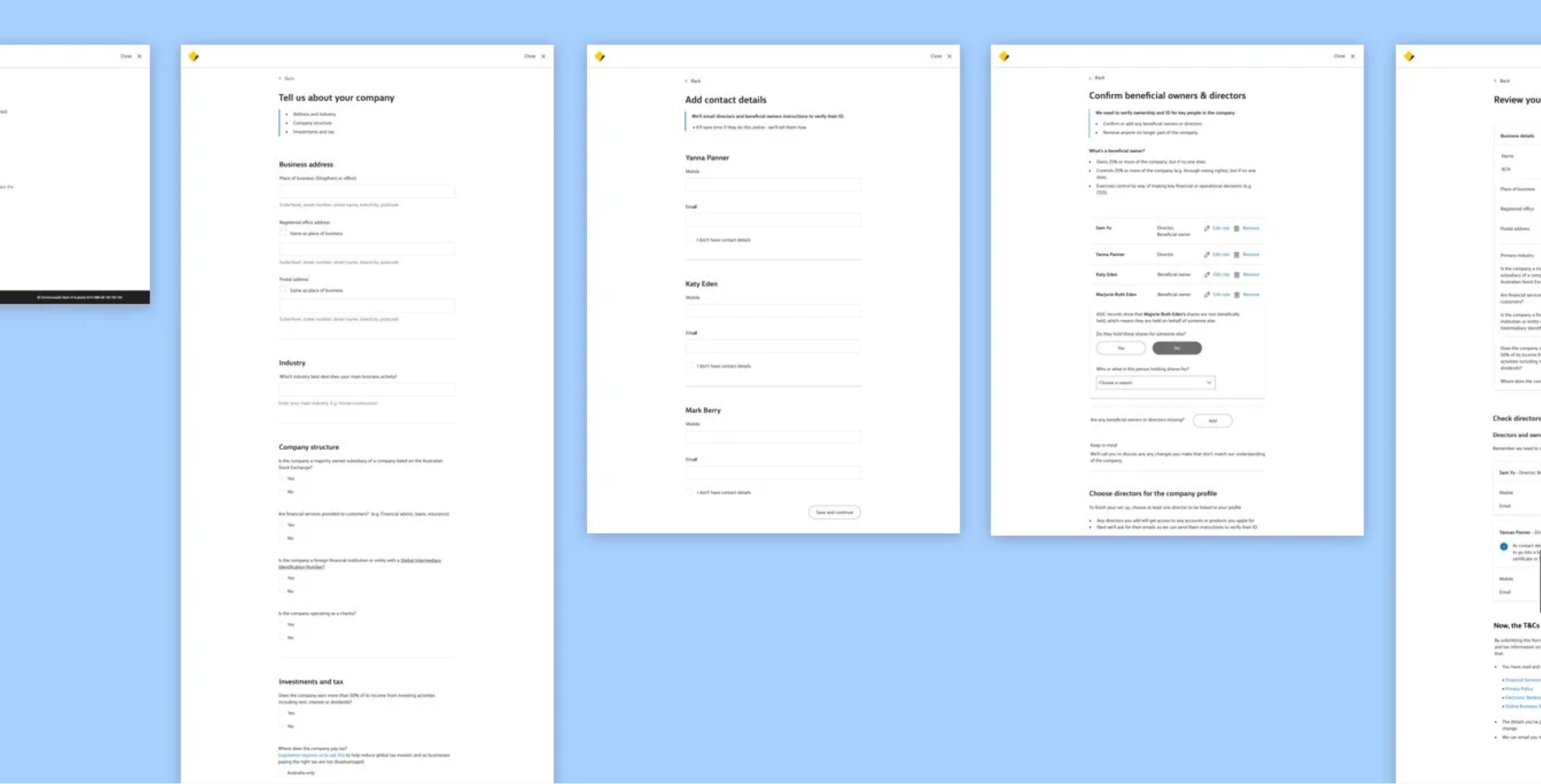
Bringing Path into CBA Design Ecosystem
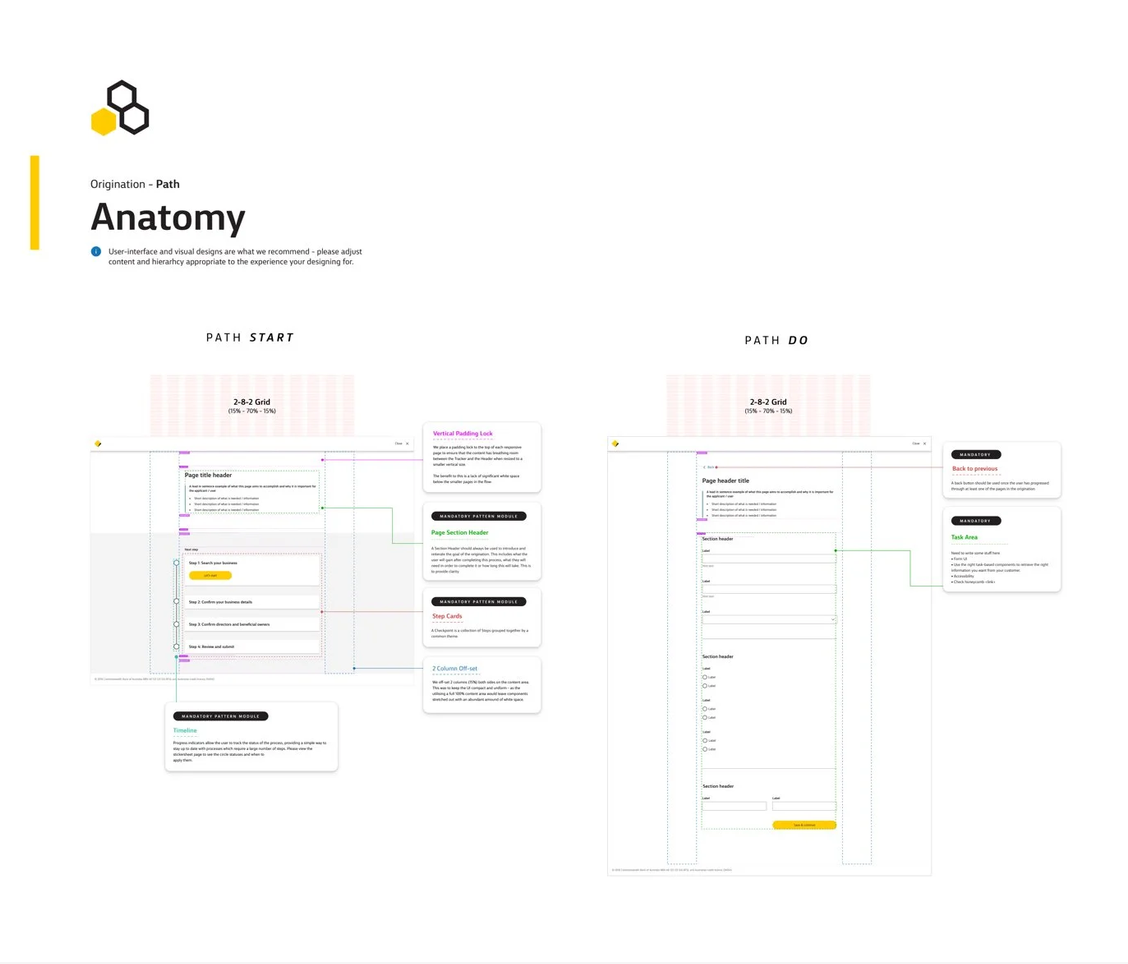
The Path origination pattern was introduced not only as a new onboarding solution for the bank, but also as a comprehensive design that was integrated into CBA's design system, Honeycomb. This made it possible for other teams to easily incorporate the pattern into their own experiences, such as Home Loans and Lending.
As the designer of the Path UI framework, sharing this new capability with other product teams across the business opened up new opportunities for streamlining their own experiences but also having more consistent experiences across the bank ever-growing digital channels.
Iterations and visual improvements for added customer delight
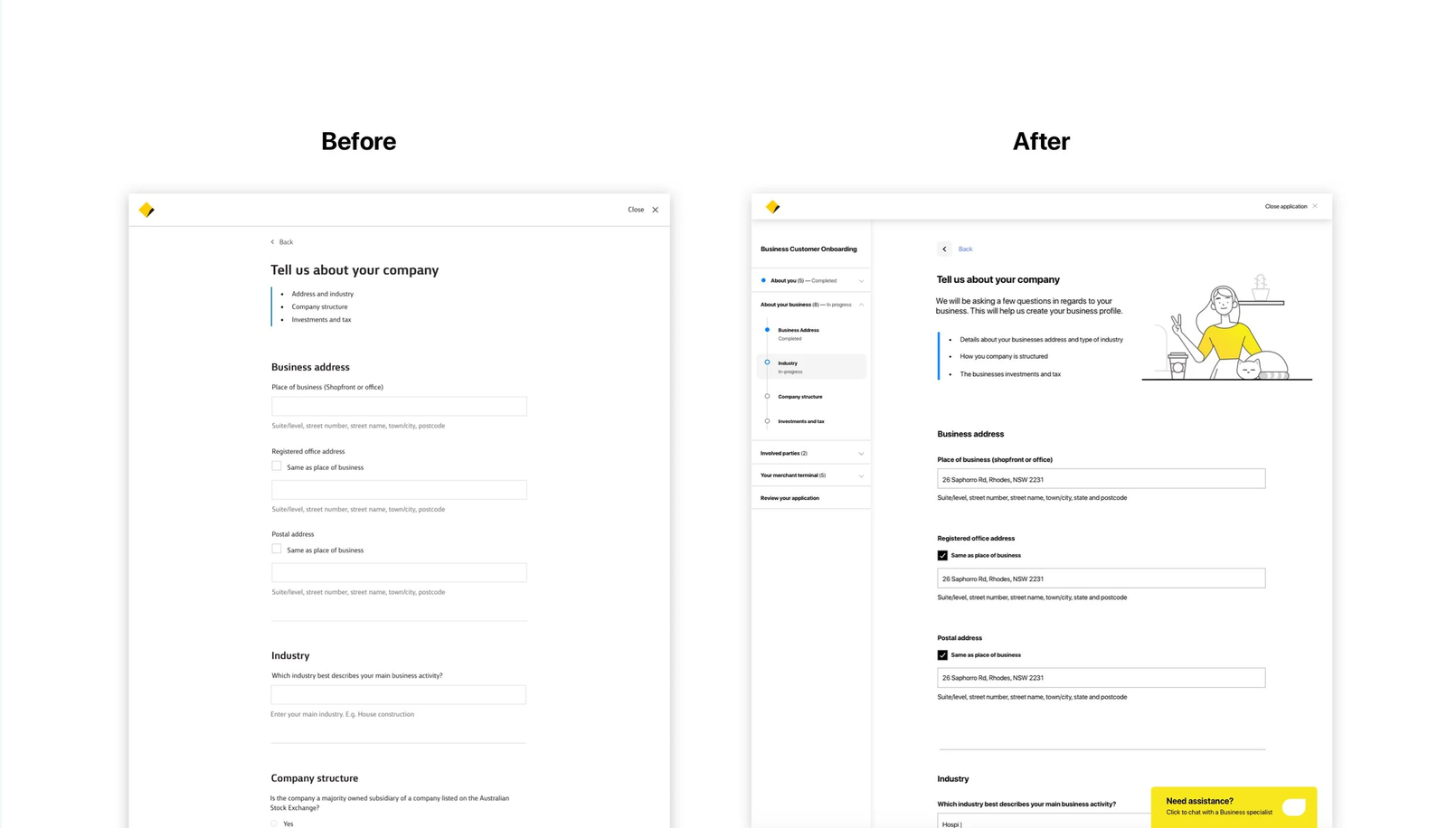
The Path Origination pattern underwent constant iterations and improvements to make it both visually appealing and intuitive. As a result, it evolved into a robust and stronger interaction pattern.
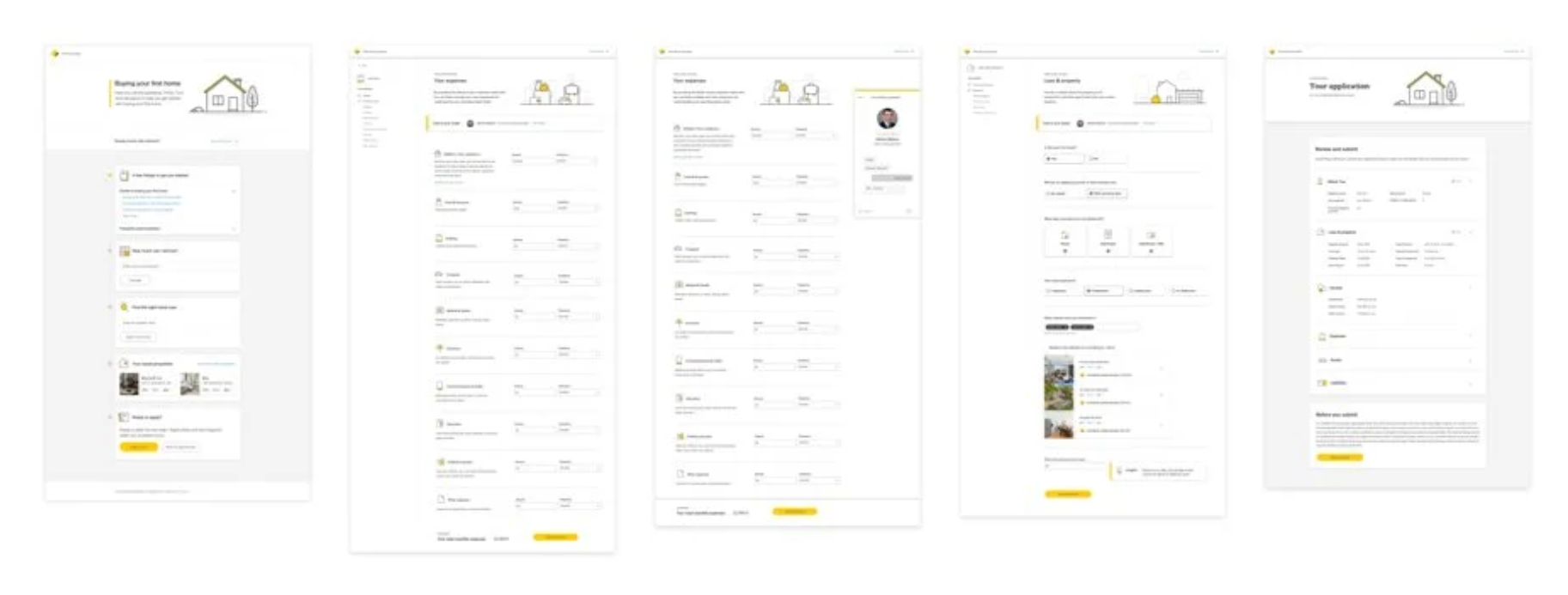
I also conceptualised how Path would be able to accommodate complex application experiences like CBA's new proposed Home Loan origination products i.e. capturing expenses, property details, digital assistants with lending specialists
A more positive experience for customers and internal processing staff
The Business Customer Onboarding initiative resulted in a more positive experience for both customers and internal processing staff, leading to increased sales. It also introduced a new interaction pattern that provides a digital-wide efficiency gain for the entire design team and its associated product teams.